My Thoughts on the New Draft 2 Digital Fees

MY THOUGHTS ON THE NEW FEES DRAFT2DIGITAL ARE CHARGING AUTHORS

A few years back, Smashwords and Draft2Digital merged. The word was that the merge wouldn't affect the present authors that Smashwords had and that my books would eventually be transferred to Draft2Digital (D2D). About a year or so later, my books were transferred and things went back to normal.

About a year ago, I received an email from D2D saying that they will be charging $12 for accounts (authors) that earn less than $100 per year. I don't earn $100 a year, which meant that I would eventually be paying $12 every year if I don't get my sales up. I decided to wait and see. My sales might suddenly go up and I could pay the $12 easily. It didn't.

A week ago, I received an email from D2D saying that they had deducted $12 from my account because my sales was below the $100 threshold. Unfortunately, my account did not have $12 in it. It had been already sent to me some time ago. So now, my account has less than $0 in it. It's negative.

I sat around thinking about what to do. I also did some Google searching to find out what other people were saying or doing about the new fees. It seemed nobody liked it but some said it was okay or even necessary. Obviously, those peole were earning more than a $100 a year. Others, however, were so enraged that they simply closed their accounts. However, before I made a decision, I decided to find out why D2D was doing this.

There has been a proliferation of AI created ebooks and these were of very low quality. These "authors" were creating hundreds of books and flooding D2D's systems. So, D2D decided to make it unprofitable for these "authors" to continue submitting these "AI slop" by charging these fees (there's also a $20 fee for new authors).

Another reason is that maintaining ebooks in their servers costs money. So, if a lot of ebooks don't sell, D2D is losing money paying to keep the ebooks while not earning from them. Most of those AI generated ebooks are of very low quality—from what I heard—and D2D is being swamped with hundreds, maybe even thousands, of low quality, AI generated ebooks.

Now, I don't know how much it costs to keep my books in D2D's servers. Will it cost $12 per year? I don't know. However, if they are charging me $12 so they can keep AI generated ebooks out of their systems, it sounds unfair. Why punish me?

The problem is, these fees are hurting authors like me, authors who are honest, hard working writers, who refuse to let AI do their writing for them.

D2D said I could do one of two things. I could close my account or I could delist my books. Closing my account is what it sounds like. My account will disappear from D2D, and my books will disappear from all the ebook stores. I will be an author with no outlet to market my books.

Delisting removes my books from the bookshelves. My account will still be active and I would not longer be charged the $12 fee. However, since my books are no longer being sold, I won't be earning anything. And if I don't earn, I will definitely not be able to pay the $12 fee.

There's another thing about delisting that doesn't make sense. If one of the reasons for charging the $12 fee is the cost of keeping my books in D2D's servers, what's the difference between keeping my books active and delisting them? In both instances, the books are in their servers so, not charging for delisting while charging for keeping them can't be the reason.

So, if I stay and don't delist, I pay $12 because my books don't earn $100 per year, If I delist, I won't have to pay $12 but I won't be earning. It's the classic "no win" situation.

I'm thinking, should I just go look for someone else to sell my books? It certainly looks like the only recourse open to me. That or selling my books myself, which isn't going to be easy and might take a long time before it becomes profitable.

But I'm not going to do anything that drastic yet. I'll wait and see if D2D will change its policy because of the outcry. I don't know how long I need to wait, I'll just have to wait and see.


Fig. 1 - Evolution of covers for Legend of the Moon

Legend of the Moon was my first novel and my favorite book. Unfortunately, it is not my bestselling book. I figured that part of the reason was the cover. Over the years, I've made changes to the cover (left to right, earliest to latest) in hopes of triggering more interest. I can't afford a cover artist, so I make my own. 

For the first cover, I took a photo of the moon, colorized it to make it bluish, and another photo of my kid's Anakin Skywalker action figure, which I then converted into a silhouette. Finally, I added features to Anakin to make him appear as if he's a knight wearing chainmail armor plus a sword strapped to his side.

As can be seen, the image of the knight is poorly drawn, and the blue moon is unnatural. I agonized over it for a few months before deciding to change it.

The next cover featured a vertical sword in front of a moon with a metallic ring around it. I felt I needed a moon, and I thought the sword looked decent enough. I also shrunk my name because I felt I didn't qualify to have my name in big, bold letters yet. This cover lasted several years because I couldn't think of anything better. 

Several months later, I was looking at images of medieval swords, and I discovered that the hilt needed to be longer. Bothered by the short hilt, the third cover now has a longer hilt and looks a bit better. I can't remember why, but I shrunk the moon and the ring. I also used a full moon instead of a somewhat half-moon. Asking around for comments from friends, some said it looks a bit mysterious. A few people thought the book was about people from the moon invading the Earth. I needed a new cover . . . again.

With the latest cover, I did something I told myself I would never do. I used AI. I described one of the scenes in the book, and I liked the image it generated. I wanted the image to fill the cover, however. I asked AI to create a cover, complete with the title and author's name, and I wanted the image to fill the whole cover. For some reason, the AI said it couldn't make a full cover, and it could only make images with square dimensions. So I made a cover with the right dimensions, pasted the image on it, added the title, and my name. I have to admit, I think it came out rather well.

I uploaded the new cover to Smashwords, and about a week later, I received a notification that the book was back on the Premium Catalog. Now I wait to see if sales will improve.

I'm willing to use AI for making my covers, but not for writing my books. I'm not going to give up my work to a piece of software. (",)

How to Avoid/Reduce Feedback in Sound Systems

The principal cause of acoustic feedback

Most, if not all, of us have experienced hearing that piercing whistle from sound systems. What causes it, and what can we do to minimize or eliminate it?

There are several types of feedback, but in this case, the proper name is acoustic feedback, the type of feedback that you can hear. In simple terms, feedback happens when the sound from the speakers enters the microphone/s, goes through the mixers and amplifiers, out through the speakers, and back into the microphone/s. In the case of guitars, the sound from the speakers makes the guitar strings vibrate, which goes through the sound system, out the speakers, and vibrates the strings again. So, essentially, the sound is going 'round and 'round the sound system.

Feedback may be caused by microphones, guitar pickups, and other sound system inputs, along with speakers. They can range in frequencies from a low rumble to an ear-splitting shriek.

So, how can you prevent your sound system from going into feedback?

Factors that can trigger feedback and solutions you can apply:

1 – System volume. The louder the sound, the more likely the sound will reach the microphone.

Solution: Reduce the volume and/or speak closer to the microphone so you can lower the volume. You can also use noise-cancelling microphones.

2 – Speaker to mic proximity. The closer the microphone is to the speaker, the more likely that feedback will occur.

Solution: Get the speakers as far away from the microphones as practically possible.

3 – The microphone is pointing at the speaker (the sound has a direct path toward the microphone).

Solution: Orient the speakers so they are pointing away from the microphones. It's easier to do by using unidirectional (a.k.a. cardioid) microphones.

speaker vs mic placement

4 – Room has a lot of reflective surfaces (even if the microphone is not pointing at the speaker, sound from the speaker can reach the microphone from reflections from the walls, floors, and ceilings).

Solution: Cover the walls, ceilings, and floors with sound-absorbing materials. You can also install slats on the walls to break up reflections. Upholstered chairs will also help. If the chair is unoccupied, the upholstery will absorb sound. If the chair is occupied, the person sitting on it will absorb sound.

sound absorbers or sound diffusers on walls

5 – Room has parallel walls and parallel floor, and ceiling. Sounds that bounce back and forth between parallel walls create "standing waves" that take longer to die down.

Solution: Same solution as #4. You can also build the room so that it doesn't have parallel walls, ceilings, and floors.

non-parallel walls (with sound proofing/diffusers)

Other solutions:

1 - Install "phase delay" equipment. These devices will shift the phase of the incoming sounds so that they will not generate "constructive interference" or sound that adds on to itself.

2 - Use a "cut-only" equalizer and a spectrum analyzer to reduce the frequencies where the feedback occurs. These are equalizers that don't have plus adjustments, only minus adjustments (the 0 dB is at the top of the sliders) and have bandwidths of 1/3-octave. When you increase the system volume and feedback starts to occur, you check the analyzer to find the frequency of the feedback and reduce the level of that frequency. Keep increasing the level and cutting the frequencies of the feedback until you attain your target system volume.

cut-only equalizer (A.K.A. room equalizer)

You can also use equalizers with cut and boost controls. The difference is, cut-only equalizers usually have a larger cut range than cut and boost types.

Urei brand room equalizer

Note: these days, you can download a spectrum analyzer app to your phone. It should be accurate enough for general sound system adjustment.

Another Fake Proposal

email supposedly from Kindle Direct Publishing

I received another email with a proposal to convert my book into a movie. This time, it's from Kindle Direct Publishing. It's obviously fake because the sending address is amazon_submissions_at_gmail_com. Amazon using a gmail address?

Furthermore, my book is hardly a bestseller. If it was a bestseller, I'd understand if someone would contact me with a proposal such as this but it's nowhere near being even a moderate seller.

Lastly, if some big movie production outfit really wanted to convert my book to a movie, I don't think they will ask me to submit a screenplay. Of course, they would offer to make the screenplay for me, which means I will have to pay for it. I would think a real proposal would be free.

If you're also a budding author and received something like this, don't believe it right away. Look at the sending address. If it's a gmail, yahoo, or other free, public email service, don't believe it.

Design Flub Fixed


Pinout diagram of Zilog Z80 microprocessor

Back around 1989, I received a request to fix an infusion pump, a device that allows medical staff to pump very small and precise amounts of fluids and medicines into patients.

I was told it would turn on, but wouldn't start pumping. The display showed rubbish, and pushing buttons didn't produce any response.

I opened the thing and quickly discovered a Z80 microprocessor, a computer chip that I had been studying for some time with the intent of building my own computer. I was very familiar with it.

From the description of the problem, it seemed as if the unit was not starting up properly. Opening the unit and checking pin 26 (the RESET pin), I found...nothing, the pin was floating (unconnected to anything).

The chip needs the RESET pin to be held at 0 volts for about a split-second after power-on to start the program at the beginning. If the chip is not reset, the program may start at a random line, and the unit will likely hang or run erroneously.

A resistor, diode, and capacitor usually sufficed to do the job of resetting the chip, but in this case, there was nothing. I told the owner that I needed to buy the parts and would return the next day.

At home, I checked the Z80 user manual. While it explained what the reset pin was for and how to use it, the manual didn't say it could be left unconnected. Unfortunately, it also didn't say that a reset circuit was required. Anyway, I already had a course of action, and I'd know after I put in the parts whether the unit would function or not.

The next day, I brought the parts, a soldering iron, and some soldering lead to the client's office and soldered the parts in. There was no provision on the board for them, but there was sufficient space for me to place them without difficulty. Once finished, I crossed my fingers and turned on the power.

Yes! The infusion pump's display gave an initial display and waited for input. Someone set it up, inputted some parameters, and pressed Start. It worked! A few more tests, and we declared the unit fit for use.

While basking in the thrill of a successful repair, I was concerned about the seeming design flaw in a commercial medical product. I told the client that they should inform the manufacturer about what we had found so they can recall the units already sold and have them updated. I went home fully expecting to soon receive a call from some engineer wanting more details. Unfortunately, there was none. They had either understood what the problem was and implemented the fix, or they had discovered the issue themselves and were already putting out a recall order.

Anyway, this was just one of those repair jobs that sticks in my memory due to its unusual nature.

Zero Sales Since June 2023


Updated cover for U-1215 Smashwords version

Sales for U-1215 has become zero since June of this year. It's strange because I had consistent sales almost every month prior to this.

Quarterly sales of U-1215 from 2016 to 2023

I don't know what happened so I sent off an inquiry to Smashwords. They said that it's probably due to a "long tail distribution." What's that?


A long tail distribution is a type of statistical distribution that seems to explain what probably happened to my book.

A book may do very well at the beginning but over time, will start to slump, meaning sales will start to slow down. There may be many reasons why this happens so I won't try to give examples. Eventually, sales drops to a much lower level than at the start and it may drop down to zero or stay at a low level indefinitely.

If a book is very well written, sales may increase sharply and then plateau after some time. In this case the vertical part of the long tail refers to increase in sales rather than the total sales.

I'm not sure if this is the case with U-1215. If you look at the quarterly sales chart, sales started to increase in 2018 and did very well during the pandemic years (2020-2022). In 2022 it seemed as if the sales volume was starting to go down but in the first half of 2023, sales spiked (much to my delight) and suddenly dropped to zero (much to my disappointment).

Yesterday, in a bid to try and solve the problem, I changed the cover of U-1215 (Smashwords edition) to see if that will restore sales. 

The last sale was in June 2023. It's almost December 2023 and the sales report is still zero. Is this a long tail distribution phenomena? I have no idea. (".)

Update 08 Feb 2024: 

In December, I received a notification that I had a sale, six months after the last, and received $2.05 in my Paypal account. There have been no other sales since then. I need to write another novel but I'm not getting any ideas at the moment. (".)

Scam Alert! Film Adaptation Proposal


This would have been a perfect start to a day...if this were true.

I received this email today and, I have to admit, it got me excited...for a while. What author wouldn't be, right? You get an email from someone claiming to be from a film/television production company and proposing to turn your book into a film or television series. Wow! Hollywood, here I come!

As I read through the email, red flags started to wave. The first paragraph says it's from Rhiley Roads and yet, the email address is from Adam Mckay, the CEO of Hyperobject Industry. Furthermore, the email address uses a gmail extension. Curious. Shouldn't an official email come from a corporate email address?

I checked out Hyperobject Industries. It's a legit company run by Adam McKay and they've produced several movies and television series on Netflix. This email, however, uses the words "Hyperobject Industry" instead of "Hyperobject Industries." When you're representing a company, you can't afford to make mistakes like that.

I don't know how these companies work. Do they really read someone's book and just contact them offering to convert the book into a movie?

They also want to pitch the book at a Producer's Pitch Event in January 2024. I checked for the event and found a Hollywood Pitch Festival scheduled for December 2023. I don't know if this is the same or is it a different event.

The final red flag is that they want ME to make the synopsis, loglines, film treatment, and screenplay. That's not something an ordinary author would know how to make. Therefore, they propose to hire professional screen writers to do it for me. Guess who pays for those? Yup, me!

If they really wanted to make a film adaptation of my book, they would contact me properly and they would propose to pay me, not me pay them.

Still, getting a legit offer would be nice. I just have to remember to be realistic and wary of scam artists like this one. (",)

New Book - RTD Temperature vs Resistance Tables

RTD Temperature vs Resistance Tables

Those who know me know that I'm an instrumentation professional and I've been in the profession since 1985. One of the instruments that I've handled many times are RTDs, or Resistance Temperature Detectors. These are temperature measuring devices and are very popular in industries due to their accuracy, temperature range, and low drift. Handled and installed properly, they will last almost indefinitely.

RTDs operate on the principle that metals change their electrical resistance in response to temperature. This means that you can determine the temperature of the RTD by mea-suring its resistance.

Unfortunately, there many types of RTDs and each type has a different resistance at any given temperature. This is usually not a problem because instruments that use RTDs as a temperature measuring sensor perform the conversion of resistance to temperature internally.

However, if the instrumentation technician or engineer doesn't have such an instrument, and all he has is a digital multimeter or a resistance meter (devices that can measure resistance) or a resistance decade box (devices that can simulate resistance), he needs to know what resistance corresponds to what temperature. This book gives that information in the form of tables.

You can get these tables on the internet, yes, but you'll likely get only one table for one type of RTD. To get tables for other types, you'll need to perform several searches. Also, the smallest temperature interval you can get is 1°C. If you need to know the resistance of a fraction of a degree (e.g. 43.6°C), you'll need to perform a small calculation and you'll probably need a calculator.

This book gives the resistance values at temperatures ranging from -200 to 650 or 850°C for Pt100(385), Pt100(3916), Pt100(3926), Pt200(385), Pt500(385), and Pt1000(385), the most commonly used RTD types in use today. Furthermore, the book lists the resistances for temperatures at 0.1°C intervals. You're getting a very comprehensive source of information for temperature-to-resistance tables.


U-66 vs USS Buckley: Duel in the Atlantic (adaptation of a true story)

cover of U-66 vs USS Buckley

Just published my newest book, U-66 vs USS Buckley Duel in the Atlantic. It's a book that's been in the works for around seven years. 

Back in 2016, while I was researching for information about U-boats for my other book, U-1215, I came upon the story of U-66 and USS Buckley. The story I found was short so I went looking for more information about the event. The best source was from USS Buckley's after action report at the uboatarchive website. It detailed the almost minute-by-minute retelling of the whole battle.

With no thought of publishing the story as a book, I gathered every bit of information I could get and filed them in a folder in my computer. I went ahead and published U-1215 and forgot about U-66.

During the pandemic in 2020, the movie Greyhound came out. While watching it, the surface battle between the USS Greyhound and the u-boat struck me as very similar to the story of U-66 and USS Buckley. I decided to review the story and make it into a book.

I wanted to tell the story from both sides but all the information came from the American side. There was almost no information from the German side. I found an report on the interrogation of the captured survivors of U-66 but it offered very little information about the German side of the battle. There was no choice, I would have to invent some of the scenes.

Even though I decided to use my imagination about the German side of the story, I didn't want to abuse my artistic license but just coming up with sensional details. The scenes had to be plausible so as to be believeable. Besides, I didn't want to put "based on a true story" in the book. As far as I was concerned, it was to be a historical retelling of the event.

I started writing in 2022 (can't remember what month I started but it was around the last quarter of the year). I didn't concentrate on it, however. I was also busy trying to build my YouTube channels (Yes, plural) so I couldn't devote 100% of my time on it. I finished the book in July 2023.

With the book writing done, I needed to create a book cover image. I had a choice of two scenes: a front view of the destroyer escort and the u-boat side by side, blasting away at each other from what seemed point blank range (indeed, the battle did involve such distances). The second choice was an aerial view of the battle showing the two vessels maneuvering around the sea from the point of view of a US Navy aircraft that was watching the two gladiators duke it out below him.

Unfortunately, I couldn't find images that would work. I thought of hiring an artist but I couldn't afford them at this time. In the end, I decided to just put images of the destroyer escort and the u-boat side by side, empty of people and just lying there as if abandoned. If I could afford an artist in the future, I'll change the cover eventually.

The actual battle lasted only 16 minutes so the book is only 5,743 words, which qualifies it as a short story. Here's to hoping that it does as well, if not better, than U-1215, my best seller.

Old-style Calculators


This is something you don't see anymore.

Back when I was a kid, I saw this rectangular thing on Dad's table. It had a slideable strip in the middle and a transparent sliding window with a thin line down the middle. There were numbers all over it that, at first, made me think it was a fancy ruler, but the number spacing was all wrong. It couldn't be a ruler, so what was it? Ever the curious kid with a fascination for technical stuff, I asked Dad what it was (after experimenting with it for a while).

He called it a slide rule.

So, it's a ruler without the extra "r", I thought. So, how does it measure things?

He said, "You don't measure with it. It helps me calculate things, like with multiplication."

I guess my eyes went wide. My first thought was, "This thing can help me with my math?"

"How does it work?" I asked him.

He asked me to give him two numbers to multiply. I decided on something simple. I wanted a test that I knew the answer to so that I'd know if the thing really does what Dad said it could do.

"Two times three." 

He starts demonstrating. "You move the slider bar until the '2' is here, then you move the sliding window until this marker is on the '3.' Then you can see that the answer is here, it's '6'."

I tried a few other numbers, and the thing gave the correct answer every time. Wow! That's neat!

He also had a circular one that worked in much the same way.

Fast forward about five years or so. I was in high school. I noticed that the third or fourth-year students were holding slide rules. It was a sort of status thing. If you held one in your hands, you were almost an engineer. There was a giant slide rule in one of the laboratories (maybe ten feet long) that was used to train the students on how to use them. I couldn't wait to get to their level so I could have my own slide rule.

It wasn't meant to be. The calculator began to appear around 1975 or so, and it promised to be vastly better than the slide rule. The slide rule ceased to be part of the curriculum, and this status symbol disappeared almost instantly. 

Calculators were better. I bought a few of them during high school until I bought a programmable one when I was in my fourth year. It's what got me started in programming.

The TI-57 programmable calculator

Occasionally, however, I see a picture of a slide rule and the memory of my first encounter with it comes back. Sometimes I'd think of buying one just for the heck of it. Maybe something to impress my grandchildren with, just as I was.

New Book My Facebook Notes is Out

My latest book, My Facebook Notes, is finally published and is available at Smashwords, Kobo, and Barnes & Noble. I expect it to appear soon in other online bookstores that Smashwords distributes to. So, what's it about?

When I first joined Facebook back in 2009, I immediately noticed the Notes feature. My friends were using it to post inspirational articles, but I wanted to be different. I decided to use it to write about my experiences with my travels. Those series of posts later became my first book, Funny Stories from My Travels (now retitled, Travel Mashups and Mishaps).

Then, I began writing smaller stories, funny anecdotes, inspirational notes, and various other things. I had dozens of those notes and might have gone on and on if not for a change on Facebook.

Around September 2020, Facebook announced that they were discontinuing the Notes feature. People could no longer make new notes, but the old notes would still be available for viewing.

I was saddened by the loss of an outlet for my creative juices. I immediately began copying the notes to MS Word files and kept them on my computer in case Facebook decided to delete them. One day, a little more than two years later, I got the idea to compile these notes and put them into a book. That's how My Facebook Notes came to be.

I pasted them into a single Word file and arranged them by topics. There were my speeches, my tips on public speaking, memories, tips on writing and publishing books, and other notes and stories. There are 150 of those notes in the book.

After the book was finished, I uploaded it to Smashwords and soon got the message that it had been accepted and was now being distributed to other ebook distributors.

I chose the title My Facebook Notes because, first of all, it is a compilation of my Facebook Notes. Second, I thought it was unique that other people might not think of sharing their own notes. I later learned, I was wrong.

While searching for the book by Googling it, I discovered that there were other books with the same title, and they too, were about notes that the authors converted into books. It was not an original idea after all.

No worries, though. Titles cannot be copyrighted, so it's common to find books that have the same titles. There are even movies that have the same title. I can change the title, but I'm not going to do that just yet.

Airline Woes


My family recently had the sad experience that our brother suddenly died. I decided to go to Bacolod to see him one last time before he was cremated.

But this post is not about my brother. It's about the experience my wife and I had with the airline that we took. I'm going to make a video about my brother but I haven't decided if I will make a blog post about him.

I bought tickets for me and the wife several days in advance. The flight was on Monday and the tickets were purchased four days earlier. Since there were no direct flights to Bacolod from Cagayan de Oro, we had to have a layover in Cebu. Our flight to Cebu was scheduled for 1:35pm, arriving in Cebu at 2:25pm. The next leg was Cebu to Bacolod, departing at 4:45pm and arriving at 5:50pm. 

The first sign of trouble was an email informing us that our Cebu to Bacolod leg had been cancelled so I had to find another flight. I was able to get a flight that departed Cebu at 7:30pm and arrived in Bacolod at 8:35pm. So, instead of a layover of 2 hours and 20 minutes, it had become 5 hours and 10 minutes. We'd have a late dinner but that couldn't be avoided.

The trip started from Cagayan de Oro a bit late. The departure was delayed by about 30 minutes (can't remember exactly). This was just the beginning. We arrived in Cebu and settled down to wait for our next departure. It was around 3pm so we had a long wait until our 7:30pm flight.

It was already around 6:50pm when we heard the announcement that our flight will be delayed because the plane that was supposed to take us to Bacolod had not yet arrived. The airline was kind enough to provide snacks and then dinner (Jollibee one piece chicken with rice). At least we didn't get hungry.

It was around 9:30pm when the plane arrived. It discharged passengers and then began boarding around 9:50pm. We took off around 10:20pm and arrived in Bacolod around 11:20pm. That's about six hours after our original, scheduled arrival.

The wake for my brother was from March 13 to 16 (Monday to Thursday) and our departure was on March 18. On March 15, I received an email saying that our 8:30am flight from Bacolod to Cebu had been cancelled. The only choice for us was a layover in Manila instead of Cebu. Again, no choice.

Come March 18, we arrived at the airport for our 11:15am flight. We'd have a two hour layover in Manila which meant we'd have lunch at the airport in Manila.

It felt like deja vu when we received word that our flight was delayed. We would be taking off around 12:30pm. The trip is about an hour and ten minutes. We'd have to hurry to our gate to make our connecting flight.

The flight to Manila was uneventful except for the last part. Air traffic meant that our arrival would be delayed. Nothing we could do about it but just hope for the best. 

Eventually we got clearance to land and we touched down around 2:10pm. The boarding time for our flight to CDO was 2:40pm. We hurried through the airport and in our haste, got lost. We actually passed the departure entrance but didn't see it. We wandered around the airport until we spotted the sign that identified the departure entrance.

There was a long line to get to the x-ray machines but my being a senior citizen saved the day for us. We got ahead of the line and entered the departure lounge. We hurried through the different gates and finally arrived at our gate. They were already starting the boarding process. Loida and I decided to visit the restroom before lining up. Again, being a senior citizen gave us first dibs on boarding.

Another bonus, they told us that they'd be taking our baggage and putting them in the baggage compartment, for free. We won't have to lug them up into the plane. The flight left around 3:30pm.

Just a funny aside. Our boarding passes didn't have a gate assignment yet. I did see on the big screen what our boarding gate was so it wasn't a problem. When we were already seated in the plane, I received a text message from the airline telling me what gate we were supposed to board. I shook my head. Things were really messed up with the airline.

The flight home was uneventful. We arrived around 5:30pm. At the airport in CDO, our baggage took some time to come out but that was just the last hurrah for all our troubles. We took the Magnum van to Limketkai and had dinner at Jollibee. We got home around 8:20pm.

The airline wasn't finished with us, however. The next day, I received another text message from the airline reminding us of things concerning our flight (check in, baggage rules, and baggage check-in procedures).

This airline has a lot of complaints about its services. I felt I just went through five years worth of problems with them in just a week.

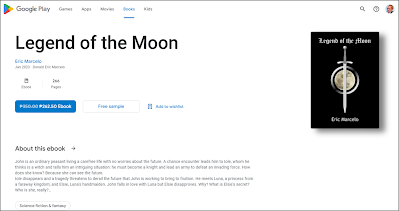
Legend of the Moon is on Google Play Store!


Legend of the Moon is now available in the Google Play Store.

I decided to put it up in the Play Store because, first of all, the Play Store is not included in the list of bookstores that Smashwords distributes to. The second reason is, the Play Store is not included in the list of bookstores that Smashwords distributes to.

Okay, so it's obvious what the reason is. I don't have to give the third reason, right? (",)

Anyway, Legend of the Moon is my first attempt at writing a novel. I put in about six months' worth of work into that book. I didn't even intend to make it into a book at first.

It started as a short story on my other blog. I was thinking, "I'll just make it three posts long, just three acts, and it's done."

As I wrote the story, I began adding elements, other situations, more characters, and soon, it had ballooned into several posts. Finally, I decided I'd change it into a full-length novel and deleted the story from the blog and rewrote it in MS Word. It took about six months of writing and a month or so of editing. Then I uploaded it into Smashwords and, there it was, my first full-length novel.

It was while writing this novel that I discovered my writing style. I was a "pantser", someone who writes novels "by the seat of their pants". You get an idea, type away, and stop. You get another idea, type some more, and stop. Sometimes, you "get into the groove" and you type almost non-stop for several hours, the ideas seemingly flying into your brain like bats flying into their cave to nest. Sometimes, the stop extends for several days or even weeks before another idea comes up.

It's not very efficient, but there's a certain element of suspense in writing this way. It's as if you're the reader instead of the writer. You don't know what's going to happen next, how the story progresses, or even how it will end.

And that's how I'm writing this post right now. Write a paragraph, stop, write another one, and stop. I'm not sure how I'm going to end this. It'll come to me eventually.

My Newest Book - Sunrise Sunset


Cover photo for the new book

It's December 31, 2022 and I wanted to end the year on a high note. After 5½ years, I have published a new book!

Sunrise Sunset is a collection of 26 of my favorite sunrise and sunset photographs. Most of them were taken at the San Lorenzo Ruiz Church. It's a great place to take these kinds of photographs because the place is on top of a small hill. I call it the San Lorenzo Ruiz Hill but that's a misnomer because the church is not really the highest point.

This was the work of a few hours in just one afternoon. After pasting the pictures on the Word document, I created the cover using Powerpoint and uploaded the two files onto the Smashwords website. It was literally that simple.

I needed this so that I can get the inspiration to finish the books I have on the pipeline. It's been so long.

House Plan for 84 Sq. Meter Lot

So, my family and I live in an 84 square meter lot that had a pre-built house on it. It's our first house (and, so far, our only house) and we've been living in it since 1998.

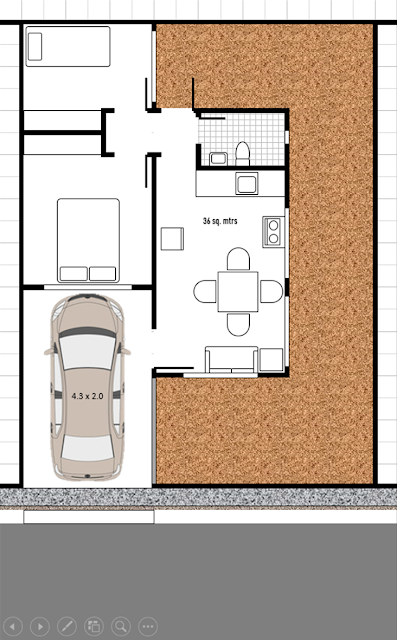
Fig. 1  Original layout of the house.

The house had two bedrooms, one toilet and bath, and a space that combined the kitchen, dining, and living room. It had 36 square meters of floor space, which was enough for Loida and me, and our four-year-old daughter. There was a generous space around the front, side, and back of the house that was planted with grass and served as our washing and drying area. A small parking space (so small, you can hardly open the car door to get in or out) completed the package.

The biggest disadvantage of the house was the small kitchen, so small it would be more appropriate to call it, the cooking nook. So, one of the improvements we thought about was using the back space as the kitchen.

Fig. 2  Planned extension

We thought of using the two meter by five meter space at the back for the kitchen. That meant that the combined space could now be used as a dining and living area, a bit more spacious and comfortable.

Unfortunately, this plan never materialized. Although my salary was more than enough for us to live with some comfort, it would still take us years to save up to implement this extension. So, it never happened (both the wife and I avoid borrowing if we can).

Fast forward about 18 years. Our family had grown from three to five with the addition of a boy and another girl. We still had the same house, in its original configuration (Figure 1). It was leaking in places, and was too small for a family of five. Our eldest had just finished college, the second was just starting college, and the youngest was in Grade VI. All three kids were sharing the second bedroom.

We needed a larger house. Actually, we needed a larger house years before but we didn't have the finances for it. Even though my salary had grown over the years, our decision to prioritize our kid's education by putting them in one of the best (read, expensive) schools in the city meant that savings were not enough. The opportunity came, however, when I retired.

With my retirement money, we decided to fix up the house. The original plan  (Fig. 2) would not be enough because we also needed an additional bedroom. The two girls would have one room and our son would have his own room.

But we also needed to replace the roof. The leaks were so bad that the expense of replacement versus repair would probably not be very different. So, I sat down in front of my computer and began drawing. We got a contractor and construction began. The house was finished in a few months in 2016.

Fig. 3  Present layout of the house

Figure 3 shows the house as it is now. Except for a two-meter wide space along the side for drying clothes and a one-meter wide space along the front, we had used up almost all of the lot. We now had three bedrooms, the living and dining areas were roomier, and there was a space at the back for a counter, cabinets, and cupboards.

The bathroom was now a two-by-two meter room. I had originally intended for it to have a dividing wall between the shower and the toilet but the engineer who was doing the construction remarked that doing so would make the space too tight. So, instead of two small spaces, it was now one very large bathroom.

The kitchen, sadly, is still small. I am not an architech and a two-by-two space looked big enough on paper but turned out to be a too small. Loida's unhappy with it and I blame myself for it.

As you can see, in order to get our third bedroom, we had to sacrifice our garage. You can only park on the street now.  It's not unusual though. Nearly every house along our street is the same.

Fig. 4  Front view of the renovated house

So, Figure 4 is the front of the house. It looks very much different from the original (which, unfortunately, I don't have a picture of). Loida has converted the space in front into a sort of conservatory that doesn't have glass walls or roof.  In spite of the small kitchen and large bathroom, it's a really nice house. A credit to the engineer who built it, Regie Lumapas.

* * *

Before I end this, I've been wondering if I could have converted the house into a detached house and still have three bedrooms. It turns out, yes, it's possible. The only way to do that is to give up the notion that a bedroom needs to be roomy. If I kept the bedrooms small, I could have enough space for the rest of the house that would still be comfortable. Below are two examples of such a house:

Fig. 5  Single detached #1

In Figure 5, all the rooms are corner rooms, which enables all rooms to have two walls with windows.

The kitchen is larger than the present one and is in a U-shape. The open end of the U faces the dining table for convenience.

The toilet and bath would be at the back of the house and close to the bedrooms. I prioritized the bedrooms for proximity to the toilet. I had thought of putting a guest's toilet closer to the living room but that meant losing the side door going to the washing area. That also meant that there would be only one exit, which seems to be a bad idea.

A shelf near the side door is for storage of everyday items or can be used as a pantry shelf. I originally put another shelf on the other wall but that meant the living area will become too small.

The dining table is a fast-food style table since it occupies a smaller footprint than the one in Figure 3.

Fig. 6  Single detached #2

Figure 6 is my favorite design. The sleeping quarters are now clearly separated from the living areas and the boundaries between the living area, dining area, and the kitchen can be easily determined. The kitchen is more spacious (should make the wife happy) and includes a storage shelf near the back door (upper left). There's not enough space for a separate pantry but a tall shelf should serve the purpose nicely.

The dining table is the same type in Figure 5 because it's the only type that will fit in the space available and still sit six people.

The three-seater sofa serves as a sort of wall between the living and dining area but it can be turned and placed against the wall for additional space if necessary.

The bedrooms are still minimalist but that's the only solution if you want three bedrooms. The toilet and bath is still at the back of the house and cannot be seen from the living area, a feature that Loida prefers.

The corridor in front of the rooms is wide enough to accomodate a row of shelves for storage of extra bedsheets, bedcovers, pillows, single mattresses, and other items. Another shelf near the toilet and bath serves to store soap, shampoo, extra towels, spare toothbrushes, toilet cleaning materials, etc.

* * *

I could make a half-dozen more designs but I'm probably not going to be building another house anytime soon. I just wanted to see if I could fit three bedrooms into a house that fits into an 84 square meter lot with at least one meter space between the property walls.

As you can see, yes, you can. (",)


A Smile, A Giggle, A Laugh, A Guffaw

Sometimes, as I'm walking around in malls, on the streets, or in offices, I spot a face that I don't give a second glance to. He or she may be looking at me, maybe even smiling at me, but I continue on, unmindful. A few seconds later, the face suddenly registers, and a memory is tickled. I look back to check, but often the owner of that face has gone, and I am left wondering if I knew him or her. There are times when the tickled memory lets out a giggle and vague scenes play out in my mind. The face seems to fit one of those people in my memory, but I can't be sure. Sometimes, the memory laughs out loud, and I'm sure I know the person, but the name escapes me. There is a tinge of embarrassment that I might have snubbed the person and maybe even ruined a friendship. But occasionally, the memory bursts out in a guffaw, and I remember both face and name. I turn around and hope he is looking my way so I can greet him. Often, he is, and we may exchange smiles, a wave, a handshake, or a word or two. It's a nice feeling to meet someone and acknowledge that you once knew them. So, if you see me around town and I seem to ignore you, don't think bad about me. It may just be a slow memory day for me or it may be my myopia. Give me a tap, and if my face has that blank look, tell me your name and where we met. I'll be glad to share a smile, a giggle, a laugh, or even a guffaw. (",)

Charles Schulz's Pen

I have been a fan of the Peanuts comic strip since the 1970s. I bought the comic books by saving the leftovers from my school allowance and read them over and over. Sadly, those comic books disappeared as the family moved residences, and I lost track of them. The internet, however, has enabled me to see the gang any time I wanted to. My favorite happens to be Snoopy.

Now, I used to be a fairly decent artist, drawing with pen and pencil. My artistry, unfortunately, is limited to copying photographs or other drawings. I also avoid coloring my drawings because adding color ruins the drawing. I'm still a kid who can't keep the colors inside the lines. So, all my drawings were either black and white or grayscale, and one of my favorite drawing topics is, of course, Snoopy.

Most of my Snoopy drawings were personal, handmade greeting cards sent to my friends, which means I don't have them anymore.

I made other drawings, but one of my favorites was made back in the summer of 1977. I had to take summer classes for Chemistry, and our teacher required us to put a periodic table in a folder, and we had to bring that folder to school every day.

Most of my classmates bought ready-made tables and pasted them on the folder, and drew a title and the owner's name on them. I, on the other hand, painstakingly drew the table, lettering in the name of the elements, their symbols, and other information.

Getting inspired by the effort of drawing the periodic table, I began drawing Snoopys all over the folder, and there was a theme to it. The folder was a very important, secret document that had to be protected. So, I drew a Snoopy in his trenchcoat garb with a speech bubble that said, "Here's the world-famous secret agent guarding this secret document."


Another drawing was of Snoopy on his doghouse and his World War I Flying Ace persona, also with a speech bubble that said, "Here's the World War I Flying Ace patrolling the skies to keep this secret document safe."

The last was Snoopy in his familiar lying-down-on-his-doghouse pose, eyes closed, and his speech bubble said, "Here's the world's greatest watchdog guarding this...ZZZ."

The folder got a lot of interest among my classmates, and at the end of summer classes, one of the girls in my class asked if she could have it. I said, yes, and that's why I don't have it anymore.

As I got older and began working, I drew less and less until I stopped completely. And, since my family changed residence several times over the years, I lost track of my other drawings until only one remained.

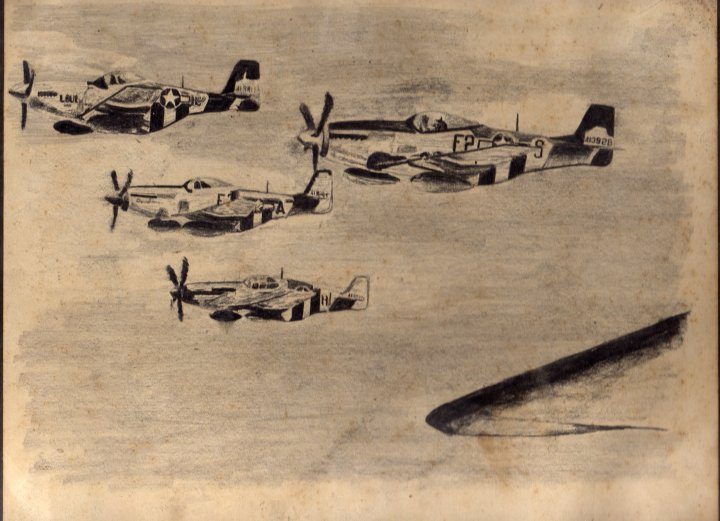
It's a drawing of a flight of P-51 Mustangs that I copied from a World War II history book. I can't recall when I drew this, but it might have been in the early 1980s. About six years ago, I bought a frame, mounted the drawing in it, and hung it up on the wall. I thought, "At least I saved one of them."

Then, about three years ago, I received this pen from my sister. 

In the note that accompanied it, she wrote:

Note: this is not my sister's handwriting. The original note is a little worse for wear, 
so I just used a script font and pasted it here. Phil is my brother-in-law, my sister's husband.

I looked at the pen in awe. I was holding an actual pen used by Charles Schulz, the creator of the Peanuts comic strip.

I immediately thought of putting it in a frame, but, for one reason or another, didn't get around to it until a little over a week ago (Oct 26, 2022). The pen had been sitting inside my closet for the past three years or so, and I saw it while looking for something else. I thought, "It's time to put you in a frame."

I got an illustration board and, for the first time in decades, drew a picture. It was Snoopy (who else?) viewed from the side, with a little smile as he walked. I found an old unused frame and put the drawing in it, and placed the pen on the drawing. Perfect.

It looked great! There was just one problem, though. The frame didn't have a glass cover. Without a cover, the picture and the pen would become dirty over time. The frame also didn't have a provision for a glass cover, and even if it did, the frame wasn't deep enough. The pen actually protrudes above the lip of the frame. So, even though I loved the frame as it was, I couldn't use it.

The wife suggested that we have it professionally mounted. There's a business not too far away that would mount the picture and pen in a custom-made frame. So, my wife took the picture and pen and gave it to them for mounting in a frame. As of this writing, I'm still waiting for it. It should be ready in about two weeks. I'll update this blog entry when I get it.

So, at least I still have the touch. Since I'm retired, I have more time to draw, but it's not really part of my interests right now. Still, if an inspiration should come, why not?

Update: Nov. 9, 2022

The newly framed Snoopy with Charles Schulz's pen just arrived! The workmanship of the framing is great! The pen is fastened to the picture using a transparent nylon string that is difficult to see unless you look very closely. I like it very much.

This is now a very much cherished heirloom. (",)

Mom's Pregnancy Story


Mom and Dad at their wedding / Mom back in 2014, @ 79 years old.

Just before I got married, I had a little conversation with Mom and Dad regarding how to handle pregnancy, not how to get my future wife pregnant, but what to do after. Among the questions I asked was, were there any things I needed to know besides the medical side of things?

Dad smiled and told me to watch out for women's peculiarities during pregnancy. Some women, he warned, seem to do weird stuff when they get pregnant. Mom laughed and began telling this story:

* * *

During one of Mom's pregnancies, Mom told Dad that she wanted an orange.

Dad said that, sometimes, preggies look for food that is either difficult or impossible to get. Compounding the problem is that you really have to find what she wants, or there'll be big problems, usually characterized by crying sessions, silent treatments, and, sometimes, physical harm. He was, however, relieved to hear Mom say she wanted an orange because oranges happened to be in season at the time.

"Don't worry, Hon. First thing tomorrow, I'll go and buy you an orange," Dad said.

Mom's face became downcast.

"I don't want you to buy it," she said.

"What? What do you mean?" Dad asked, confused.

"I don't want you to buy it, I want you to steal it," Mom said, deadpan.

"But, but, I can't do that. What if I get caught?" Dad tried pleading with her, but it was no use; Mom stood her ground.

"Basta! I want you to steal it," Mom angrily said.

(Basta is a Tagalog word that translates as "no arguments" or "no ifs or buts about it.")

Dad was aghast, but he didn't want to go against Mom's wishes. "A pregnant woman must be followed," he said.

"Okay, I'll go steal one tomorrow."

Now, Dad's a nice guy, and stealing simply wouldn't do. He bought an orange. When he got home, he presented it to Mom.

"Here's your orange, Hon! I stole that," he proudly declared.

At that moment, Dad discovered that pregnancy seemed to give women a sixth sense because Mom saw through his ruse.

"You didn't steal that, you bought it!" Mom shouted, immediately followed by crying.

Dad panicked. One thing you should never do is to upset your pregnant wife. The consequence could be a possible miscarriage, they informed me. 

Dad hugged Mom and patted her back.

"Okay, okay. I'll go back outside and...steal an orange."

So, Dad went back out. He didn't say how he did it, but he went and stole an orange somehow.

He came back to the house and presented it to Mom, who did something really strange.

She wordlessly took the orange and put it inside their closet. She never took it out, never ate it, she just left it there until it shrivelled and turned black.

* * *

And that's where the story ended. I remember Mom and Dad laughing as if it were just a small, funny incident from their past. I, on the other hand, was dumbfounded. Dad had somehow pulled off a heist, but I had no illusions about my ability as a thief. I was sure that I would be caught, and using the reason, "my wife is pregnant," would not pass muster.

This thought stayed with me for several months until my wedding. On my wedding night, while my new wife was sleeping with her back to me, I lay on my back thinking about Mom's pregnancy story. What if the same thing happened to my wife? I mean, some things run in families, right? The thought that my wife belonged to another family didn't occur to me.

So, I did what I should do as a Christian. I prayed.

I extended my hand toward my sleeping wife's back, but not touching her so as not to awaken her. Besides, the Good Book says that anything you tell the Lord in private is heard, and I decided this was one prayer that I wanted God to hear.

So, I prayed fervently to God to please, PLEASE, not let my wife experience, during her future pregnancies, anything that would cause us to sin or suffer.

I've heard it said that a passionate prayer is a true prayer and one that God will take note of. And I believed it.

So, 29 years later, my wife and I have had three children. During her pregnancies, she didn't experience morning sickness, no cravings, and no demands for me to start on a life of crime. God had heard my prayer.